
Start your journey to becoming a certified tester today!
Explore ISTQB Certifications for Software Testing excellence.
Connect with our experts for guidance and support.
Certification Provider
Certification Board
Certification Level
Certified Tester AI Testing (CT-AI) Version 2.0
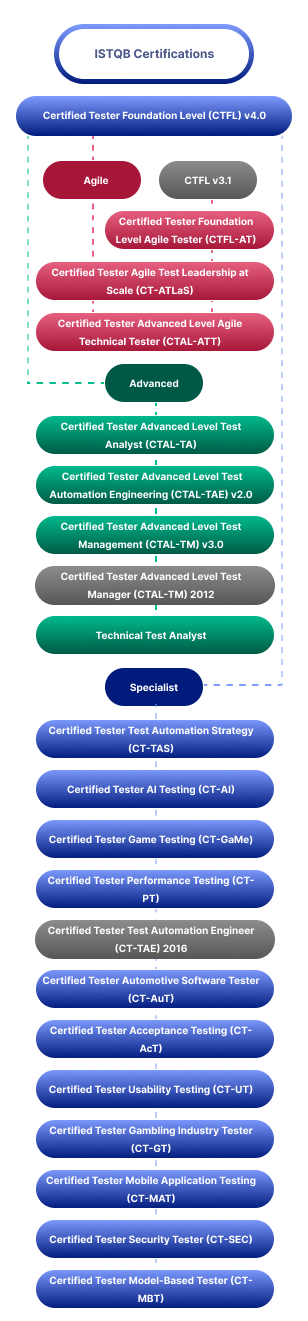
The ISTQB® Certified Tester AI Testing (CT-AI) v2.0 certification focuses on testing AI-based systems, including machine learning systems and generative AI systems such as large language models. It provides the knowledge required to design and execute tests for AI-based systems, addressing their specific characteristics, including probabilistic behavior, non-determinism, and reliance on data. It also introduces AI-specific quality characteristics relevant to testing AI-based systems. The syllabus follows a lifecycle-based approach, including input data testing, model testing, and ML development testing, together with relevant test approaches for modern AI-based systems.
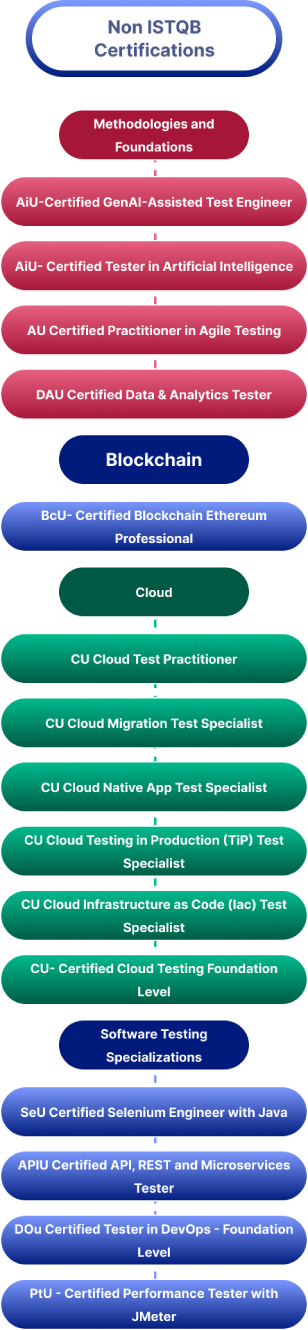
Artificial intelligence was founded as an academic discipline in 1956. It is only in recent years that the capabilities and AI and ML have really grown into everyday topics, which are becoming integral parts of many IT projects. There are endless possibilities and uses for AI and ML which can bring incredible benefits; however, as with many new technologies, it is important that we understand them well so we can better consider potential ethical implications. This is why, at AiU, we believe that the most important thing is knowledge.
Data & Analytics United - Certified Data & Analytics Tester (DAU - CDAT) is a 2-day interactive certification course to help you develop the skills and knowledge to survive as a tester in a data and analytics environment. Participants will learn how to utilize embedded structured testing in order to reach and improve the quality goals in their everyday work. A Certified Data & Analytics Tester is not only able to define a vision and test strategy, but also apply it to an efficient test approach in data-oriented environments and projects. They are also familiar with the essential test specification techniques that are required in data and analytics projects. Successful DAU - CDAT participants are able to distinguish between different data quality attributes, measure these differences and apply essential data profiling techniques. They will also understand the intricate privacy aspects of the data that is associated with the given test environments and apply this to their data and analytics testing
Ethereum is the world's largest Blockchain platform for building distributed, smart contract driven Blockchain applications. At the same time, Ethereum is undergoing rapid changes to its API, consensus mechanisms and the solidity programming language used for writing smart contracts. Many online learning resources tend to become outdated very quickly. For someone wishing to learn Ethereum, it becomes quite challenging to find up to date courses and learning content. To solve this problem, we have designed this course to enable participants to learn from the latest version of the platform. We keep the course up to date by continuously updating the content whenever changes occur.
Agile United - Certified Practitioner in Agile Testing (AU - CPAT) is a three-day intensive, hands-on and interactive training to help you develop skills and knowledge to survive as a tester in an agile context and grow your career in the testing & quality field. It will sharpen or change your paradigm of testing and quality in an agile context. This practical training will provide you a variety of approaches and techniques to think and talk about testing and quality and improve your hands-on (people, agile, testing and tooling) skills.
The ISTQB Certified Tester Foundation Level (CTFL) certification is the cornerstone of essential testing knowledge that can be applied to real-world scenarios. The syllabus provides a comprehensive understanding of the terminology and concepts used in the testing domain worldwide, making it relevant for all software delivery approaches and practices, including Waterfall, Agile, DevOps, and Continuous Delivery. CTFL certification is recognized as a prerequisite to all other ISTQB certifications where Foundation Level is required.
The ISTQB Model-Based Testing (CT-MBT) certification focuses on an advanced test approach of using models for testing. It extends and supports classic test design techniques such as equivalence partitioning, boundary value analysis, decision table testing, state transition testing, and use case testing. It is an innovative approach to improve effectivity and efficiency of the test process.
The inherent characteristics of cloud computing architecture is utilized to create cloud native applications. The CU - Cloud Computing Native Apps Specialist (CCNAS) certification course focuses on the essential cloud computing delivery model, its architecture, and specific tests that a tester is required to know to accomplish the tasks at hand. The certification itself is independent of any specific cloud provider; however, hands-on exercises will be performed on several of the most widely-known providers and hybrid scenarios as well. The objective of the Cloud Computing Native Apps Specialist certification is to enable the testers to understand the architecture and inherent characteristics of the cloud native apps and able to perform various types of specific tests and understand the different Hyperscalers and the tools available for performing specific tests.
The ISTQB Agile Test Leadership at Scale (CT-ATLaS) certification focuses on how to organize and improve quality and testing across multiple teams in an agile organization. It also covers how to approach quality and testing at a strategic level in order to achieve higher business agility in an organization. CT-ATLaS covers how to scale testing and quality assurance efforts by fostering a quality mindset and culture across the organization. This includes shifting from a traditional test management approach typically used in sequential development models to a quality assistance approach which builds on Lean and Agile principles and values. It also includes how to adopt common Lean and Agile techniques and processes for analyzing and solving problems and how to use them to improve testing and quality in the organization.
The ISTQB® Certified Tester AI Testing (CT-AI) v2.0 certification focuses on testing AI-based systems, including machine learning systems and generative AI systems such as large language models. It provides the knowledge required to design and execute tests for AI-based systems, addressing their specific characteristics, including probabilistic behavior, non-determinism, and reliance on data. It also introduces AI-specific quality characteristics relevant to testing AI-based systems. The syllabus follows a lifecycle-based approach, including input data testing, model testing, and ML development testing, together with relevant test approaches for modern AI-based systems.
Benefits Provided

Earn globally respected certifications to enhance career prospects, develop specialized skills, and access wider job opportunities. Boost your professional growth, confidence, and network with recognized credentials in software testing.
ISTQB offers a range of benefits for companies that become ISTQB partners, enabling them to demonstrate their commitment to software testing certifications, enhance their visibility, and collaborate with the ISTQB community.
ISTQB® offers a range of benefits for training providers, enabling them to deliver high-quality software testing education and certification services to professionals worldwide.
Companies Affiliated
Training Provider
Candidate Feedback

Software testing is an ever-evolving field, with new technologies and methodologies shaping how quality assurance (QA) is performed. As we move into 2026, staying updated with the latest trends is crucial for professionals and organizations striving for efficient and effective testing. This blog explores the top software testing trends to watch in 2026. 1. AI and Machine Learning in Testing ------------------------------------- Artificial Intelligence (AI) and Machine Learning (ML) continue to revolutionize software testing by enabling smarter automation, faster defect detection, and predictive analytics. AI-driven test automation tools can: * Generate test cases automatically * Identify patterns in testing data * Predict potential defects before they occur * Improve self-healing test scripts Companies leveraging AI-powered testing solutions will benefit from reduced testing time and enhanced accuracy. 2. Codeless Test Automation --------------------------- Codeless testing tools are gaining popularity as they allow testers to create automated test scripts without extensive programming knowledge. These tools use AI-based visual workflows, drag-and-drop functionalities, and natural language processing to simplify automation. Popular codeless automation tools include: * Testim * Katalon Studio * Leapwork Codeless automation enhances accessibility and speeds up test automation adoption across teams. 3. Shift-Left and Shift-Right Testing ------------------------------------- The **Shift-Left** and **Shift-Right** testing approaches are transforming traditional software testing strategies: * **Shift-Left Testing:** Focuses on testing early in the development cycle to detect defects sooner and reduce costs. * **Shift-Right Testing:** Emphasizes continuous monitoring and testing in production environments to enhance user experience. By integrating these approaches, organizations can ensure faster and more reliable software releases. 4. Cloud-Based Testing and SaaS Adoption ---------------------------------------- With the rise of cloud computing, cloud-based testing is becoming the norm. Cloud platforms provide: * Scalable testing environments * Faster test execution * Cost-effective infrastructure * Seamless collaboration among distributed teams Popular cloud testing platforms include **Sauce Labs, BrowserStack, and AWS Device Farm**. 5. Test Data Management and Synthetic Data Generation ----------------------------------------------------- Data privacy regulations like **GDPR** and **CCPA** have made test data management more challenging. To address this, organizations are adopting: * **Synthetic data generation:** Creating artificial yet realistic test data to ensure compliance. * **Data masking techniques:** Protecting sensitive data while maintaining test accuracy. Test data automation ensures faster, more secure, and regulation-compliant testing practices. 6. Performance Engineering Over Traditional Performance Testing --------------------------------------------------------------- Performance testing is evolving into **performance engineering**, which takes a holistic approach to improving system performance throughout the software development lifecycle. Key benefits include: * Early performance issue detection * Continuous monitoring in real-world environments * Optimized system scalability and user experience Performance engineering integrates seamlessly into DevOps and Agile methodologies. 7. Hyperautomation in QA ------------------------ Hyperautomation, a concept introduced by **Gartner**, combines AI, ML, and robotic process automation (RPA) to achieve end-to-end automation of QA processes. It enables: * Intelligent test execution and analysis * Automated defect logging and resolution * Enhanced decision-making through AI insights Hyperautomation streamlines QA workflows and boosts testing efficiency. 8. Security Testing and DevSecOps --------------------------------- With rising cyber threats, security testing is no longer optional. Organizations are shifting to **DevSecOps**, where security is integrated into every stage of development. Key security testing practices include: * API security testing * Automated vulnerability scanning * Secure code analysis * Compliance-driven security assessments Security testing ensures software resilience against cyber threats. 9. The Growing Role of Blockchain Testing ----------------------------------------- As blockchain adoption expands across industries, testing blockchain applications requires specialized approaches. Blockchain testing focuses on: * Smart contract validation * Security audits * Performance and scalability testing * Data integrity verification With blockchain’s increasing use in finance, supply chain, and healthcare, its testing will become a priority. 10. The Rise of Continuous Testing in CI/CD Pipelines ----------------------------------------------------- Continuous testing within **Continuous Integration/Continuous Deployment (CI/CD)** pipelines ensures rapid feedback and high-quality releases. Automated testing is embedded in each phase of CI/CD, enabling: * Faster bug detection and resolution * Reduced manual intervention * Seamless software delivery Popular CI/CD tools supporting continuous testing include **Jenkins, GitHub Actions, and GitLab CI/CD**. Conclusion ---------- Software testing in 2026 will be driven by automation, AI, security, and performance engineering. By staying ahead of these trends, QA teams can enhance efficiency, reduce costs, and deliver high-quality software. Organizations that embrace these advancements will gain a competitive edge in the rapidly evolving tech landscape. Stay updated with the latest in software testing—subscribe to our blog for more insights!

The ISTQB (International Software Testing Qualifications Board) Foundation Level certification is one of the most recognized certifications for software testers worldwide. Whether you are an aspiring tester or an experienced professional looking to validate your knowledge, preparing effectively for the ISTQB Foundation Level exam is crucial. This blog post will provide actionable strategies to help you pass the exam with confidence. 1. Understand the Exam Structure and Syllabus --------------------------------------------- Before diving into preparation, it is essential to understand the structure of the ISTQB Foundation Level exam. The exam typically consists of 40 multiple-choice questions, and candidates must achieve at least 65% (26 correct answers) to pass. The syllabus is divided into key topics, including: * Fundamentals of Software Testing * Testing Throughout the Software Development Lifecycle * Static Testing * Test Design Techniques * Test Management * Tools Supporting Testing Downloading the **official ISTQB syllabus** from the ITB website will help you align your study plan with the exam objectives. 2. Plan Your Study Schedule --------------------------- A well-structured study plan is crucial for effective preparation. Allocate at least **4-6 weeks** for studying, depending on your familiarity with software testing concepts. A recommended study schedule includes: * **Week 1-2:** Focus on understanding fundamental concepts and terminology. * **Week 3-4:** Deep dive into test design techniques and management topics. * **Week 5:** Solve practice questions and review weak areas. * **Week 6:** Take full-length mock exams to assess readiness. 3. Use Quality Study Materials ------------------------------ Using reliable study resources can make a significant difference. Consider the following materials: * **ISTQB Official Syllabus & Glossary** – The best source to understand exam topics. * **ISTQB Foundation Level Study Guides** – Books like “Foundations of Software Testing” by Rex Black. * **Online Courses** – Platforms like Udemy, Coursera, and YouTube offer excellent video tutorials. * **Practice Exams & Sample Papers** – Many websites provide free mock tests that simulate the real exam experience. 4. Take Practice Exams Regularly -------------------------------- One of the most effective ways to prepare for the ISTQB exam is by taking **mock exams**. These tests help you: * Familiarize yourself with the question format. * Improve time management. * Identify weak areas that need improvement. Aim to complete at least **5-7 full-length mock exams** before your test day. 5. Understand Key Terminology ----------------------------- The ISTQB exam heavily focuses on testing terminology. Familiarizing yourself with key terms from the **ISTQB Glossary** will help you understand questions faster and answer them correctly. 6. Join Study Groups and Online Forums -------------------------------------- Engaging with a community of test professionals can be highly beneficial. Consider joining: * **ISTQB Study Groups on LinkedIn, Facebook, and Telegram** * **Software Testing Forums like Stack Exchange and Reddit** * **Local Meetups or Online Webinars on Testing** Interacting with peers can provide valuable insights and clarify any doubts you may have. 7. Use Mnemonics and Visualization Techniques --------------------------------------------- Some concepts, like testing principles and review techniques, can be tricky to memorize. Using mnemonics, flashcards, and mind maps can help reinforce your learning and make recall easier. 8. Focus on Time Management During the Exam ------------------------------------------- The ISTQB exam is time-bound, requiring you to answer 40 questions in 60 minutes. To optimize time management: * Allocate **1-1.5 minutes per question**. * Skip difficult questions and return to them later. * Read each question carefully before answering. 9. Stay Confident and Calm on Exam Day -------------------------------------- On the day of the exam: * Ensure you get **a good night’s sleep**. * **Review key concepts** but avoid last-minute cramming. * **Arrive early at the exam center or ensure a stable internet connection for online exams**. Conclusion ---------- Preparing for the ISTQB Foundation Level exam requires a structured approach, dedication, and the right study materials. By following these strategies—understanding the syllabus, using quality resources, taking mock exams, and managing time effectively—you can increase your chances of passing the exam on your first attempt.
Software testing is an ever-evolving field, with new technologies and methodologies shaping how quality assurance (QA) is performed. As we move into 2026, staying updated with the latest trends is crucial for professionals and organizations striving for efficient and effective testing. This blog explores the top software testing trends to watch in 2026. 1. AI and Machine Learning in Testing ------------------------------------- Artificial Intelligence (AI) and Machine Learning (ML) continue to revolutionize software testing by enabling smarter automation, faster defect detection, and predictive analytics. AI-driven test automation tools can: * Generate test cases automatically * Identify patterns in testing data * Predict potential defects before they occur * Improve self-healing test scripts Companies leveraging AI-powered testing solutions will benefit from reduced testing time and enhanced accuracy. 2. Codeless Test Automation --------------------------- Codeless testing tools are gaining popularity as they allow testers to create automated test scripts without extensive programming knowledge. These tools use AI-based visual workflows, drag-and-drop functionalities, and natural language processing to simplify automation. Popular codeless automation tools include: * Testim * Katalon Studio * Leapwork Codeless automation enhances accessibility and speeds up test automation adoption across teams. 3. Shift-Left and Shift-Right Testing ------------------------------------- The **Shift-Left** and **Shift-Right** testing approaches are transforming traditional software testing strategies: * **Shift-Left Testing:** Focuses on testing early in the development cycle to detect defects sooner and reduce costs. * **Shift-Right Testing:** Emphasizes continuous monitoring and testing in production environments to enhance user experience. By integrating these approaches, organizations can ensure faster and more reliable software releases. 4. Cloud-Based Testing and SaaS Adoption ---------------------------------------- With the rise of cloud computing, cloud-based testing is becoming the norm. Cloud platforms provide: * Scalable testing environments * Faster test execution * Cost-effective infrastructure * Seamless collaboration among distributed teams Popular cloud testing platforms include **Sauce Labs, BrowserStack, and AWS Device Farm**. 5. Test Data Management and Synthetic Data Generation ----------------------------------------------------- Data privacy regulations like **GDPR** and **CCPA** have made test data management more challenging. To address this, organizations are adopting: * **Synthetic data generation:** Creating artificial yet realistic test data to ensure compliance. * **Data masking techniques:** Protecting sensitive data while maintaining test accuracy. Test data automation ensures faster, more secure, and regulation-compliant testing practices. 6. Performance Engineering Over Traditional Performance Testing --------------------------------------------------------------- Performance testing is evolving into **performance engineering**, which takes a holistic approach to improving system performance throughout the software development lifecycle. Key benefits include: * Early performance issue detection * Continuous monitoring in real-world environments * Optimized system scalability and user experience Performance engineering integrates seamlessly into DevOps and Agile methodologies. 7. Hyperautomation in QA ------------------------ Hyperautomation, a concept introduced by **Gartner**, combines AI, ML, and robotic process automation (RPA) to achieve end-to-end automation of QA processes. It enables: * Intelligent test execution and analysis * Automated defect logging and resolution * Enhanced decision-making through AI insights Hyperautomation streamlines QA workflows and boosts testing efficiency. 8. Security Testing and DevSecOps --------------------------------- With rising cyber threats, security testing is no longer optional. Organizations are shifting to **DevSecOps**, where security is integrated into every stage of development. Key security testing practices include: * API security testing * Automated vulnerability scanning * Secure code analysis * Compliance-driven security assessments Security testing ensures software resilience against cyber threats. 9. The Growing Role of Blockchain Testing ----------------------------------------- As blockchain adoption expands across industries, testing blockchain applications requires specialized approaches. Blockchain testing focuses on: * Smart contract validation * Security audits * Performance and scalability testing * Data integrity verification With blockchain’s increasing use in finance, supply chain, and healthcare, its testing will become a priority. 10. The Rise of Continuous Testing in CI/CD Pipelines ----------------------------------------------------- Continuous testing within **Continuous Integration/Continuous Deployment (CI/CD)** pipelines ensures rapid feedback and high-quality releases. Automated testing is embedded in each phase of CI/CD, enabling: * Faster bug detection and resolution * Reduced manual intervention * Seamless software delivery Popular CI/CD tools supporting continuous testing include **Jenkins, GitHub Actions, and GitLab CI/CD**. Conclusion ---------- Software testing in 2026 will be driven by automation, AI, security, and performance engineering. By staying ahead of these trends, QA teams can enhance efficiency, reduce costs, and deliver high-quality software. Organizations that embrace these advancements will gain a competitive edge in the rapidly evolving tech landscape. Stay updated with the latest in software testing—subscribe to our blog for more insights!

The Global Partner level in the ISTQB Partner Program is the highest tier, requiring a Platinum Partnership in addition to two Gold Partnerships in at least two different countries. This level offers exclusive benefits, global recognition, and a prestigious status within the ISTQB Partner Program.

The Platinum Partner level in the ISTQB Partner Program requires a minimum of 30 certification points, including three Advanced Level Certificates. This level provides enhanced benefits, recognition, and privileges, showcasing a significant dedication to software testing certifications and professional development.
The Global Partner level in the ISTQB Partner Program is the highest tier, requiring a Platinum Partnership in addition to two Gold Partnerships in at least two different countries. This level offers exclusive benefits, global recognition, and a prestigious status within the ISTQB Partner Program.